One framework
Framework memorandum of understanding between AAIN and Gigawatt Burundi S.A., signed at Bujumbura at the 11th African Agribusiness Incubation Conference and Expo.
How it deploys
The African Agribusiness Incubators Network (AAIN) — one of the technical arms of the African Union Commission on agribusiness incubation — supplies premises, staff and relationships in each member country. PURE Power Africa supplies the equipment, engineering, procurement, training and financing that no member should build alone.
One framework
Framework memorandum of understanding between AAIN and Gigawatt Burundi S.A., signed at Bujumbura at the 11th African Agribusiness Incubation Conference and Expo.
Country memoranda
Memoranda of understanding between Gigawatt Burundi S.A. and Africa Projects Development Centre, Abuja (Nigeria), and Excel Hort Consult Agribusiness Incubator, Mbarara (Uganda); the DRC pilot is licensed and Cameroon is in preparation.
One technical base
Being established at the CEFORE-Rusi campus in Burundi under its memorandum of understanding: assembly, repair, central warehousing and the train-the-trainers academy.
Network members already carry reach: cooperatives, farmer field schools, demonstration farms, universities, government relationships, offices, staff, accountants, lawyers, customs brokers and local context. Premises and relationships exist; power does not. The hub adds power and equipment to them: there is no site to acquire, demand is already present, and program funds buy equipment rather than set up new organizations.
Agriculture and food security, health, education and skills, logistics and offtake, banking and microfinance — each delivered through the hubs by the institution mandated and budgeted to do it. The agricultural partnership in Burundi with the Food and Agriculture Organization of the United Nations is the template.
Revenue from the first day; businesses and households planned in every town. Added funding sets the speed, not the direction.
Revenue from day one
A hub where the trade is — processing, cold storage, charging, water and points of sale — selling services from commissioning, with one line to the first anchor customers where authorized.
Commercial customers
Metered, prepaid connections for markets, workshops, processors and cooperatives on the same plant, under the regulator's authorization.
Planned in every town
Household connections across the town; results-based finance, partner programs and public network investment added where available.
Acceleration, at any stage. Concessional facilities, results-based finance, donor programs and public programs where the government so decides bring the next phase, or the next town, forward.
Direct supply, beyond the town. Agro-industries, telecom towers and health facilities away from a hub, served under direct contracts where the regulatory framework allows.
Each hub, phase and cluster is financed and built on its own; a delay in one district does not stop the others.
From a 15–20 kWp market cold store to a town plant with full distribution, growing in standard blocks as demand is measured.
If the grid or another operator builds the town network, the hub continues as producer, supplier or operator under the rules then in force.
Established customers make each extension bankable; no site depends on the next one being built.
| Unit | Indicative cost | What it buys, and what pays for it |
|---|---|---|
| First market unit | A fraction of an initial hub | Cold rooms or milk chilling at a market or collection point, with charging and a point of sale; paid per crate, liter or charge from commissioning. |
| Initial hub · Phase 0 | About USD 0.5–1 million | Generation from 25–100 kWp with storage, the hub's productive equipment and, where authorized, the line to the first customers; paid by hub services and metered anchor customers. |
| Distribution · Phases 1 and 2 | About USD 2–3 million | Business, then household connections — network, meters and added capacity — phased to each town's layout and demand; paid by tariffs, with results-based finance and partner programs where available. |
| Added capacity | Standard blocks | Solar, storage and equipment added to a running hub as demand grows, with no redesign and no new site. |
| Direct supply | Priced per contract | A dedicated plant for one customer under a direct contract where the regulatory framework allows; capital recovered in the tariff. |
These figures are early, rounded estimates from the first country designs, offered to give a sense of scale. Each site is costed on its own crops, volumes, logistics and duties, so actual budgets will differ and will be refined as designs are confirmed.
A continental base, country headquarters, rural hubs and last-mile agents, each carrying what the layer below cannot support alone.
Central administration, the train-the-trainers academy, procurement, warranty and repair, financing and accounting support. Built once, used everywhere.
A country headquarters with the network member, plus anchor hubs for generation, waste-to-energy aggregation, processing and customer service.
Permanent powered sites in farming districts, each serving a cluster of villages with processing, storage, services and aftercare.
Field agents, electric two- and three-wheelers ringing each hub, extending its reach to the hardest-to-reach households and farms.
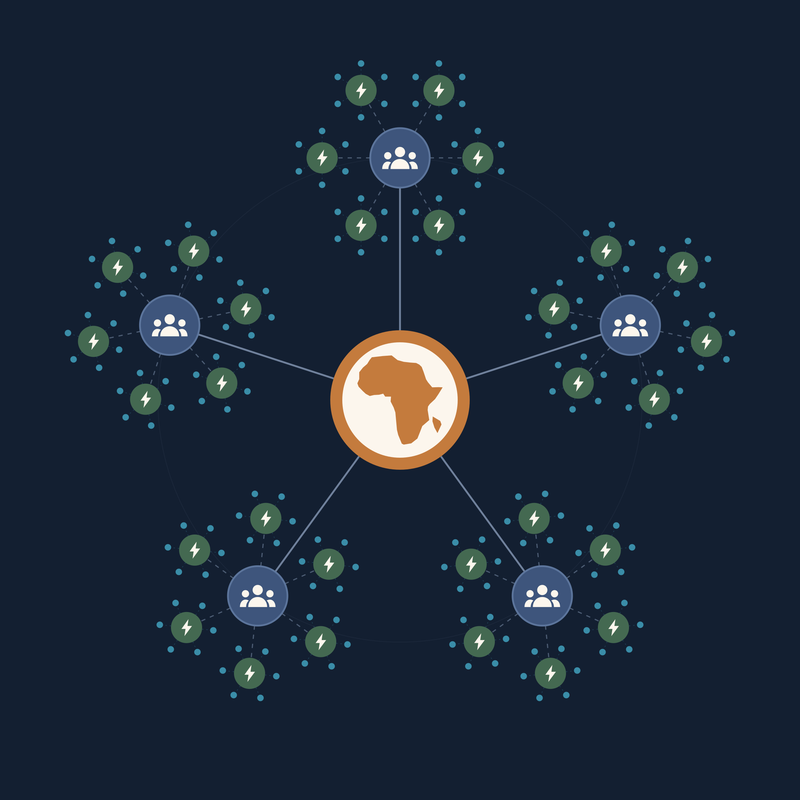
Shared logistics, administration, aftercare and data — overhead absorbed across the network, not per project.
The CEFORE-Rusi polytechnic campus in Gitega province: engineering and technical direction, the continental train-the-trainers academy, the demonstration hub and farm, assembly and quality control, the main repair center and central warehousing, and the anchor of the e-mobility network.
Direction and standards, program design, the financing seat, aggregated procurement and vendor negotiation, template legal work, government and institutional interface, indicators and data for the whole network.
The ninety-day launch phase: what the network member and the platform each do, in order, before a site is committed.
Country member and platform
Each side names a focal point. The country strategy is agreed between the continental headquarters and the country headquarters before any approach to government, funders or donors.
Country member
Contacts and relationships, existing premises and field structures, crops and volumes, post-harvest losses, existing processing capacity, and what the district will actually pay for.
Country member with the platform
Which agency holds which decision; the licenses and permits required, each with the instrument and date creating it; the customs, duty and tax route for equipment; the national, sub-national and donor programs already financed that the hubs can attach to.
Platform with the country member
A shortlist of sites with tenure, host institution, access, water and grid position for each. Equipment configured to local crops and volumes; costing built on the country's own prices, logistics and duties.
Both, jointly
Pilot region, cluster composition, sequence, partner list and funding roadmap, signed off jointly — then engagement with government and funders begins. Due within ninety days of the country memorandum of understanding.
One region
One anchor hub with standard hubs and their light spokes inside a single district cluster, so engineering, logistics and training move once rather than criss-crossing the country. Verified on utilization, collections and maintenance before the next wave is committed.
Adjacent districts, then the national layout
Clusters added next door, where the spares depot, technicians and e-mobility fleet already reach; procurement aggregated per wave. Provincial anchors placed so every site sits within a working day of the technical base; mini-grids and direct commercial supply where the gates are passed.
How the countries after the first are ordered
Partner readiness and physical footprint, electrification gap, national energy compact status, logistics corridors and regional blocs, language grouping, and security — plus proximity to the base. Hubs are staffed by seconding the host partner's field staff; the platform adds equipment, capital, curricula and management.
Method, structure, sequencing and framing travel between countries. Legal, regulatory, fiscal and tariff requirements do not. Every country dossier states which requirements are met, which are absent and what closes the gap — and country programs are sequenced on what can actually be signed locally, not on the reference timetable.
Each ministry keeps its mandate, its programs and its budget. The national hub network gives it a powered, staffed and permanent place to deliver in every district, with logistics to the villages and aftercare that continues after each program closes.
Ministry of energy, rural electrification agency, regulator, utility
Each hub is a powered site with productive load from the first day: processing, cold storage, pumping and charging. Hubs operate under the existing framework for decentralized supply, anchor mini-grids where demand is measured, and are built to connect when the grid arrives.
Ministry of agriculture, extension services, cooperative authorities
Milling, drying, pressing, cold storage and grading at the point of harvest reduce post-harvest losses and let cooperatives sell graded volume. Extension, input and irrigation programs gain a permanent, powered delivery point in each district.
Local government, provinces and communes
One hub serves a cluster of villages, with light spokes, field agents and electric vehicles reaching the farms. Communes gain a site for services, trade and training without building or staffing new facilities.
Ministries of education and vocational training, universities
Accredited courses at the hub business center, over satellite connectivity: hub operation and maintenance, solar installation, agronomy and enterprise. Tele-education reaches learners across the district; trainers are certified by the continental academy.
Ministry of health, district health services
Power, connectivity and vaccine-grade refrigeration for tele-consultation, referral and maternal and child health, with last-mile agents carrying screening to the villages. Health services deliver the care; the hub supplies the site, the cold chain and the route.
Ministries of transport and energy
Electric motorcycles and tricycles charged on hub solar carry produce, goods and technicians between farms, spokes and markets. The hub network provides charging, battery exchange and maintenance along rural routes and reduces imported fuel.
Ministries of gender, youth and employment
Hub operation, processing, sales, servicing and field-agent networks create jobs in the district. Women and young people come first for training, hub management and enterprise support, with targets set and reported jointly.
Ministry of finance, central bank, public and development banks
Produce stored and graded at the hub serves as collateral; the buyer pays into the bank and the loan is repaid at source. Public credit lines and guarantee schemes reach farmers and cooperatives through a channel with records, collection and security.
Ministries of planning and finance, development partners, implementing agencies and operators
National and donor programs — agriculture, nutrition, health, skills, energy access — use the hub network instead of building their own presence district by district.
Where a government adopts the reforms that recur in national energy compacts under Mission 300 — a simplified procedure at or below 1 MW, import tax exemption for solar and clean-cooking equipment, a rural electrification and mini-grid framework — the hub network applies them from the first cluster.
A hub contributes directly to thirteen of the seventeen goals. Results are reported on one indicator set for governments, funders and partners.